Equilibrium detectors
Working principles
A thermal detector is, in principle, a very sensitive calorimeter: it measures the energy E deposited by a single interacting particle through the temperature rise it produces, ΔT = E/C, where C is the heat capacity of the detector. The heat then flows to a heat sink through a weak thermal conductance G, so that the temperature returns to equilibrium with a time constant τ = C/G. For this mechanism to be effective the heat capacity must be very small. This is achieved by choosing suitable materials (dielectric crystals, superconductors well below their critical temperature, …) and by operating the detector at very low temperature, usually below 100 mK, in a dilution refrigerator.
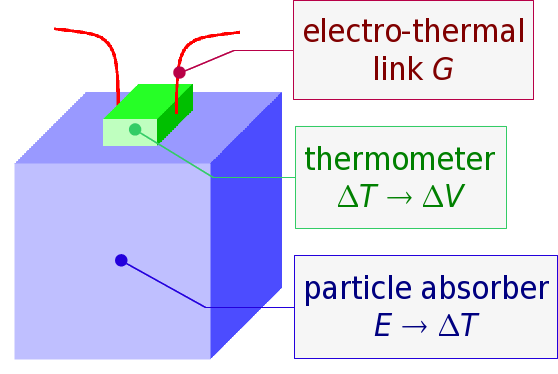 |
A thermal detector is made of three main components:
- The particle absorber is the sensitive mass of the device, where particles deposit their energy. The material can be chosen quite freely, but it must have a low heat capacity and withstand cooling in vacuum. The absorber can contain the radioactive isotope under study (the source = detector approach), which makes it possible to perform experiments such as searches for neutrinoless double beta decay, dark matter searches, or beta and electron capture spectroscopy to measure the neutrino mass. Absorber masses range from a few micrograms to almost one kilogram.
- The thermometer (temperature sensor) is in a sense the most important part of the detector, since it converts the temperature rise into an electrical signal. The main types are described below.
- The thermal link to the heat sink, which sets the recovery time and often provides the electrical connection as well.
Microcalorimeters are thermal detectors of very small size (absorber mass below 1 mg), which in general achieve a very high energy resolution: from a few eV down to below 1 eV for soft X-rays. Large detectors, with masses from grams to about one kilogram, are often called bolometers in the particle physics community, although strictly speaking this term refers to detectors measuring a power flux rather than single energy depositions.
Energy resolution
Even in the absence of any external disturbance, the energy content of a body in contact with a heat bath fluctuates because of the random exchange of energy quanta (phonons) through the thermal link. The rms amplitude of these thermodynamic fluctuations is √(kBT2C) and sets the fundamental scale of the energy resolution of an ideal thermal detector:
ΔEFWHM ≈ 2.355 ξ √(kBT2C)
where ξ is a dimensionless factor, of order one or smaller, that depends on the thermometer sensitivity and on the noise sources (Johnson noise of the sensor, phonon noise in the thermal link, amplifier noise). The resolution therefore improves at low temperature and with low heat capacity, and it does not depend on the energy of the event. This is why thermal detectors can greatly outperform conventional semiconductor detectors, whose resolution is limited by the statistics of the number of charge carriers created.
Temperature sensors
The sensitivity of a thermometer with resistance R(T) is usually expressed by the logarithmic derivative α = d ln R / d ln T. The larger the absolute value of α, the larger the electrical signal for a given temperature rise. For semiconductor thermistors α is negative (the resistance increases as the temperature decreases), while for superconducting sensors it is positive.
Semiconductor thermistors
Heavily doped semiconductors close to the metal–insulator transition conduct at low temperature by variable range hopping of charge carriers between impurity sites. Their resistance increases steeply as temperature decreases, following
R(T) = R0 exp[(T0/T)γ]
with γ = 1/2 in the Efros–Shklovskii regime. The parameters R0 and T0 depend on the doping level. Typical sensitivities are in the range α ≈ −1 to −10, with resistances in the MΩ–GΩ range at the operating point. Thermistors are biased with a constant current and read out with low-noise JFET voltage amplifiers. They are robust and reproducible and can be produced in large quantities, but they are relatively slow and their high impedance makes multiplexing of large arrays difficult. Two main technologies are used:
- Silicon implanted thermistors are made by ion implantation of dopants into silicon and are compatible with micromachining. This allows the fabrication of arrays of microcalorimeters with thermistors integrated on thin suspended membranes. They have been widely used for X-ray astrophysics and for the early calorimetric neutrino mass experiments with 187Re (MIBETA, MARE).
- Neutron Transmutation Doped (NTD) germanium thermistors are made by irradiating high-purity germanium with thermal neutrons in a nuclear reactor. Neutron capture by the Ge isotopes followed by decay produces Ga acceptors and As and Se donors, with a doping that is extremely uniform throughout the crystal. Small NTD Ge chips are glued to the absorbers. They are the sensors of the large-mass TeO2 bolometers of CUORE and of its successor CUPID.
Superconducting Transition Edge Sensors (TESs)
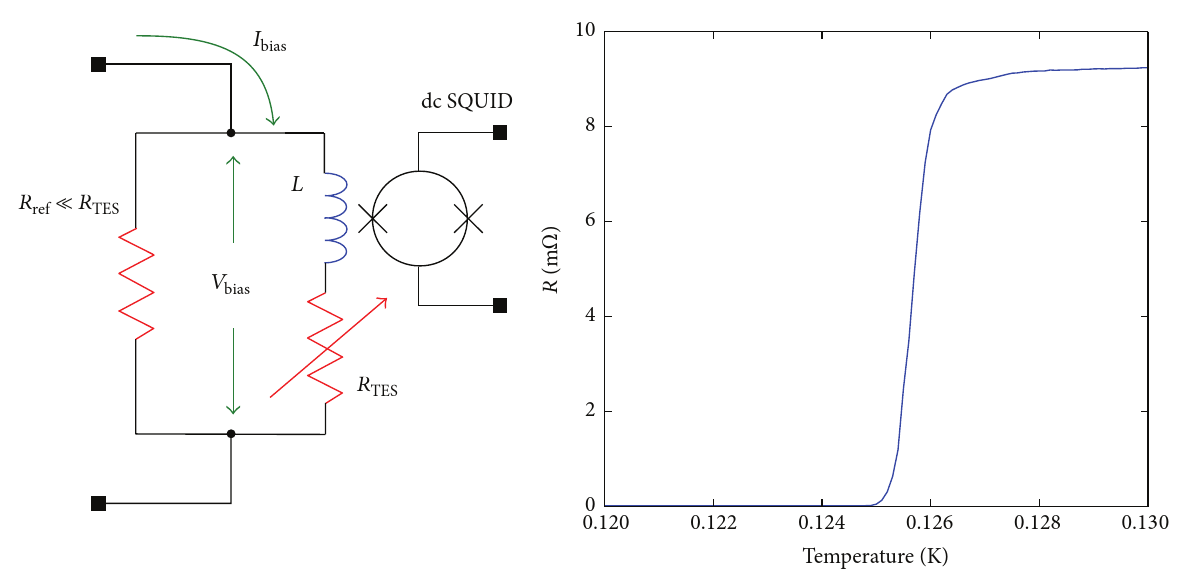
TESs are resistive devices made of thin films of superconducting material, whose resistance changes sharply from zero to a finite value within a very narrow temperature interval around the critical temperature Tc. The material can be an elemental superconductor (such as tungsten or iridium), but more often it is a bilayer of a normal metal and a superconductor. In bilayers, the proximity effect lowers the Tc of the superconductor, and Tc can be tuned by adjusting the relative thickness of the two layers. Common combinations used to fabricate TESs with Tc between 50 and 100 mK are Mo/Au, Mo/Cu, Ti/Au and Ir/Au. TES fabrication relies on standard thin-film deposition, photolithographic patterning and micromachining.
TESs reach sensitivities α of 100 or more. They are voltage biased: a temperature rise increases the resistance and therefore reduces the Joule power dissipated in the sensor. This negative electrothermal feedback stabilizes the operating point within the transition, linearizes the response and makes the pulses faster than the natural time constant C/G. Because of their low impedance (typically mΩ to Ω), TESs are ideally read out by SQUIDs, which amplify the current signal induced by a particle interaction.
TES microcalorimeter arrays are being actively developed as X-ray and gamma-ray spectrometers for many applications, including material analysis, X-ray astrophysics and particle physics. TESs are particularly well suited to be coupled to metallic (gold) or semimetallic (bismuth) absorbers, providing fast response and energy resolutions of a few electronvolts or better. In the HOLMES experiment, TES microcalorimeters with gold absorbers implanted with 163Ho are used to measure the electron neutrino mass.
 |
| Reproduced from A. Nucciotti, Advances in High Energy Physics 2016 (2016) 9153024. DOI |
Metallic Magnetic Calorimeters (MMCs)
In MMCs the thermometer is a paramagnetic alloy, such as gold or silver doped with a few hundred ppm of erbium (Au:Er, Ag:Er), placed in a weak magnetic field. The magnetization of the sensor depends on temperature (approximately as 1/T), so the temperature rise after a particle interaction produces a change of magnetic flux. This is detected by a SQUID magnetometer. MMCs dissipate no power in the sensor, have a fast intrinsic rise time and a highly linear response, and they achieve energy resolutions of a few eV. They are used, for example, by the ECHo experiment to measure the neutrino mass with 163Ho.
SQUID readout and multiplexing
Superconducting QUantum Interference Devices (SQUIDs) are the ideal low-noise, low-impedance amplifiers for TESs and MMCs. Large arrays of detectors require multiplexing, so that many sensors can share the same readout lines and keep the heat load on the cryostat and the complexity of the wiring manageable. The main schemes are time-division (TDM), code-division (CDM), frequency-division (FDM) and microwave SQUID multiplexing (µMUX). In µMUX, each sensor is coupled to a dissipationless rf-SQUID, which in turn is coupled to a superconducting microwave resonator with a unique resonance frequency in the GHz range. Hundreds of detectors can then be read out through a single pair of coaxial cables and one cryogenic HEMT amplifier, using software-defined radio techniques for frequency generation and demodulation. µMUX is the readout scheme adopted by HOLMES.
Particle absorbers
The choice of absorber material is driven by the requirement of low heat capacity, by the stopping power for the radiation to be detected, and by the need to embed a specific isotope.
Dielectric
In dielectric and diamagnetic crystals the heat capacity at low temperature is due to phonons only and follows the Debye law, C ∝ (T/ΘD)3, where ΘD is the Debye temperature. This strong suppression at low temperature allows the operation of very large absorbers, up to almost one kilogram. Examples are the TeO2 crystals of CUORE (about 750 g each) and the Li2MoO4 crystals of CUPID. Many crystals also scintillate. Detecting the scintillation light together with the heat signal (scintillating bolometers) makes it possible to identify the interacting particle, for instance to reject alpha particle background.
Metallic
In normal metals the heat capacity is dominated by conduction electrons and decreases only linearly with temperature, C = γT. Metallic absorbers are therefore limited to small masses (µg–mg). On the other hand, the energy thermalizes quickly and completely through the electron system, which gives fast and reproducible signals. High-Z metals such as gold provide high stopping power for X-rays and electrons and are the standard choice for X-ray microcalorimeters. Bismuth is a semimetal with a very low electronic heat capacity and is often used in combination with gold to make thick absorbers. Gold is also the host material in which 163Ho is embedded in HOLMES.
Superconducting
Well below Tc, the electronic heat capacity of a superconductor is exponentially suppressed and only the small phonon contribution remains. Superconducting absorbers can therefore be relatively large. However, part of the deposited energy can remain trapped for a long time in quasiparticles (broken Cooper pairs) that recombine slowly. This can cause incomplete or slow thermalization and degrade the energy resolution. Superconducting metallic rhenium absorbers, which naturally contain the beta-emitting isotope 187Re, were used in the MANU experiment to measure the neutrino mass (MIBETA used dielectric AgReO4 crystals instead). Tin and tantalum have been studied as X-ray and gamma-ray absorbers.
Non-equilibrium detectors
Non-equilibrium detectors measure the energy before it has thermalized, by sensing the high-energy (athermal) phonons produced in the absorber or the excess quasiparticles created in a superconductor. They can be faster than equilibrium detectors and are often well suited for imaging and large arrays.
Superconducting microresonators (KIDs)
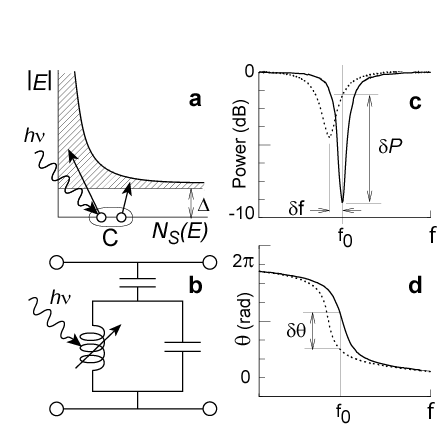
A very powerful type of non-equilibrium detector is based on superconducting microresonators. These were proposed in 2003 as Microwave Kinetic Inductance Detectors (MKIDs or KIDs) by P.K. Day et al. (Nature 425 (2003) 817, DOI). KIDs exploit the very low loss of superconducting circuits to produce microresonators with very high quality factors, Q, up to several million. Absorbed radiation breaks Cooper pairs and increases the density of quasiparticles. This changes the surface impedance of the superconductor (mainly its kinetic inductance), which shows up as a shift of the resonance frequency and a decrease of Q.
These detectors are mostly used as bolometers for millimetre-wave and submillimetre astronomy, but there are also applications to single particle detection, for example by coupling KIDs to large crystal absorbers to sense athermal phonons.
Each pixel in an array is assigned a unique resonance frequency in the GHz range. Since the detectors are well matched to low-noise cryogenic microwave amplifiers with multi-GHz bandwidth, such as HEMTs, thousands of pixels can in principle be read out on a single feedline. KIDs also have the advantage of being comparatively simple to manufacture, because they do not require micromachining of thermally isolating structures.
 |
| Reproduced from P.K. Day et al., Nature 425 (2003) 817. DOI |
Other non-equilibrium detectors
- Athermal phonon sensors: TESs or KIDs deposited on the surface of large crystals collect the high-energy phonons before they thermalize. With quasiparticle-trap-assisted TESs (QETs) this is the basis of several cryogenic dark matter experiments.
- Superconducting Tunnel Junctions (STJs): the excess quasiparticles created in a superconducting film tunnel through a thin insulating barrier and give a current signal proportional to the absorbed energy. The small energy gap of superconductors (≈ meV) gives a much better resolution than semiconductor detectors at high count rates.
- Superconducting Nanowire Single-Photon Detectors (SNSPDs): a narrow superconducting strip biased close to its critical current switches to the normal state when it absorbs a single photon. SNSPDs offer excellent timing and high efficiency for optical and infrared photon counting, and they are widely used in quantum technologies.
Further reading
- C. Enss (Ed.), Cryogenic Particle Detection, Topics in Applied Physics 99, Springer (2005). DOI. This book contains, among others, the chapters by D. McCammon on thermal equilibrium calorimeters, by K.D. Irwin and G.C. Hilton on transition-edge sensors (DOI) and by A. Fleischmann, C. Enss and G.M. Seidel on metallic magnetic calorimeters.
- A. Nucciotti, The Use of Low Temperature Detectors for Direct Measurements of the Mass of the Electron Neutrino, Advances in High Energy Physics 2016 (2016) 9153024. DOI
- J.N. Ullom and D.A. Bennett, Review of superconducting transition-edge sensors for x-ray and gamma-ray spectroscopy, Supercond. Sci. Technol. 28 (2015) 084003. DOI
- P.K. Day et al., A broadband superconducting detector suitable for use in large arrays, Nature 425 (2003) 817. DOI
- J. Zmuidzinas, Superconducting Microresonators: Physics and Applications, Annu. Rev. Condens. Matter Phys. 3 (2012) 169. DOI
- J.A.B. Mates et al., Demonstration of a multiplexer of dissipationless superconducting quantum interference devices, Appl. Phys. Lett. 92 (2008) 023514.
- CUORE Collaboration, Search for Majorana neutrinos exploiting millikelvin cryogenics with CUORE, Nature 604 (2022) 53. DOI
- B. Alpert et al. (HOLMES Collaboration), Most stringent bound on electron neutrino mass obtained with a scalable low temperature microcalorimeter array, Phys. Rev. Lett. 135 (2025). DOI